Well, last weekend was pretty good for our team here at UTD. We took top honors at the Southwest Collegiate Championship in Dallas, TX.
Crosstable
This five round event was surprisingly strong. UT-Brownsville fielded a team that included IM Axel Bachmann (who apparently has 3 GM norms), IM Dan Fernandez, WIM Nadya Ortiz, and a number of experts and class A players. Our team consisted of myself, IM Jacek Stopa, FM Ali Morshedi, FM Igor Schneider, NM Alex Chua, and experts Michael Slepoy and Yash Gogte. Though it was an individual tournament, the top four finishers from each team would count towards an overall team score. Our team won convincingly with 16.5 points!
I was pleased with my performance. My first two rounds were pretty clean wins, but the third round against WIM Nadya Ortiz was a real dogfight. This girl can play! I tried 1.Nf3, and we quickly transposed into a King's Indian Defense. The Bayonet Attack appeared on the board and she replied with the very rare 9...Nh5 10.Re1 Kh8!?. This gave me an opportunity to play 11.a4, which in retrospect is probably a mistake (11.Nd2 is better). She missed a couple opportunities to put me to the test, and the game dragged on into a knight+queen vs. bishop+queen ending where I probably held a very slight advantage with my knight blockading her isolated d-pawn. We were playing with the G/90 +30 second increment time control, so it was a pretty big shock when she flagged! True, I had won a pawn by that time, but she retained some drawing chances.
After this round, I was black against my teammate FM Ali Morshedi, who sports a nice 2379 FIDE rating. He played a very aggressive line against my Scandinavian. Fortunately, I was well prepared. This game also went the distance, and I prevailed in a rook ending. The last round was a quick draw against my friend IM Dan Fernandez to guarantee us both a tie for first.
I played next to IM Axel Bachmann for most of the tournament. Though he had an off tournament (he drew with our Yash Gogte and lost to IM Jacek Stopa), he definitely seems like a strong player. I subsequently found out that he is "olimpus" on ICC - funny, as we've played dozens of games together. It's a small world.
3.22.2007

2.27.2007
2.24.2007
IM Title
I never thought getting the IM title would be this difficult...off the board!
A lot of people have been asking me why I haven't received my title yet. The answer: I don't really know. Basically, I've been e-mailing back-and-forth with the USCF since I scored my final norm last June. I subsequently scored a fourth norm at the UTD Grandmaster Invitational in December.
Carol Jarecki e-mailed me a few days ago and said that FIDE has essentially confirmed my title, but it just hasn't shown up on the FIDE website.
This is all rather strange. Most title applications are listed on the FIDE website weeks or months before the congress meets to ratify them. My application has never been listed. For now, I'm just watching my rating card to see when (if ever!) I receive this elusive title.
A lot of people have been asking me why I haven't received my title yet. The answer: I don't really know. Basically, I've been e-mailing back-and-forth with the USCF since I scored my final norm last June. I subsequently scored a fourth norm at the UTD Grandmaster Invitational in December.
Carol Jarecki e-mailed me a few days ago and said that FIDE has essentially confirmed my title, but it just hasn't shown up on the FIDE website.
This is all rather strange. Most title applications are listed on the FIDE website weeks or months before the congress meets to ratify them. My application has never been listed. For now, I'm just watching my rating card to see when (if ever!) I receive this elusive title.
2.22.2007
2.07.2007
Bust!? Schneider - Rohonyan cont'd
I few days ago, I received the following e-mail from Tom Ewers of Minnesota:
Let's take a look at Tom's analysis. The critical position arises after 9.Bh3:
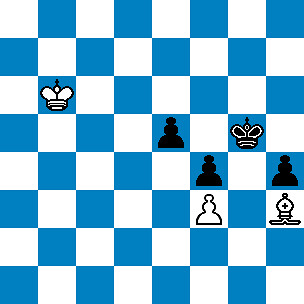
In my original analysis here, I assumed that this position was lost for black. Let's continue. 9...e4 10.fxe4 f3 11.e5 Kf4 12.e6 Kg3
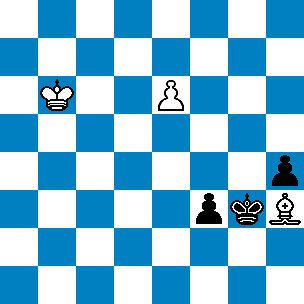
Here, Tom's line above with 12.Bf1 does lead to a draw. I tried the more obvious 13.e7, but this too seems to end peacefully after 13...Kxh3 14.e8Q f2 15.Qe2 Kg2 16.Kc5
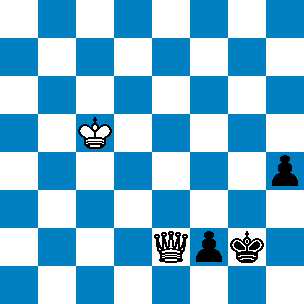
Now 16...Kg1! is a draw, i.e. 17.Qg4+ Kh2 18.Qxh4+ Kg2= with the famous bishop-pawn vs. queen endgame. Note that black's other try 16...h3 actually loses to 17.Kd4! h2 18.Ke3 h1Q 19.Qxf2+ Kh3 20.Qf5+ Kh2 21.Qf4+ Kh3 22.Qh6+ Kg2 23. Qg5+ Kf1 (if 23...Kh2, then 24.Kf2) 24.Qf4+ Kg2 (24...Ke1 25.Qf2+ Kd1 26.Qd2#) 25.Qg4+ Kh2 26.Kf2 with mate to follow.
This all looks pretty convincing to me. Simply waiting with a move like 2...Be3 is black's best plan. Now, where can we find an improvement for white!?
Thanks again to Tom for sending in his findings about this complex ending.
In the Rohonyan - Schneider game I think you have overlooked something.
1.h4 gxh4 2.Bf1 Be3 (This is one of your notes) 3.g5 Ke7 4.Kc6 Kf6 5.Kb7 Kg6 6.a7 Bxa7 7.Kxa7 Kxg5 8. Kb6 e5 9.Bh3 (Here you give +-, but I'm not convinced) 9...e4 10.fxe4 f3 11.e5 Kf4 12.e6 Kg3 13.Bf1 h3 14.e7 h215.e8/Q h1/Q At this point, my Chess Engine (with endgame tablebases) is screaming that the position evaluates to 0.00. What do you think? Also, in some of the other variations, it seems to me that Black can put up better resistance by leaving his pawn on e6 to prevent the White Bishop from going to f5 after the White g pawn has advanced. You may want to revisit some of those variations also.
Let's take a look at Tom's analysis. The critical position arises after 9.Bh3:
In my original analysis here, I assumed that this position was lost for black. Let's continue. 9...e4 10.fxe4 f3 11.e5 Kf4 12.e6 Kg3
Here, Tom's line above with 12.Bf1 does lead to a draw. I tried the more obvious 13.e7, but this too seems to end peacefully after 13...Kxh3 14.e8Q f2 15.Qe2 Kg2 16.Kc5
Now 16...Kg1! is a draw, i.e. 17.Qg4+ Kh2 18.Qxh4+ Kg2= with the famous bishop-pawn vs. queen endgame. Note that black's other try 16...h3 actually loses to 17.Kd4! h2 18.Ke3 h1Q 19.Qxf2+ Kh3 20.Qf5+ Kh2 21.Qf4+ Kh3 22.Qh6+ Kg2 23. Qg5+ Kf1 (if 23...Kh2, then 24.Kf2) 24.Qf4+ Kg2 (24...Ke1 25.Qf2+ Kd1 26.Qd2#) 25.Qg4+ Kh2 26.Kf2 with mate to follow.
This all looks pretty convincing to me. Simply waiting with a move like 2...Be3 is black's best plan. Now, where can we find an improvement for white!?
Thanks again to Tom for sending in his findings about this complex ending.
Updates Coming
School has had me on lockdown the past week or so. Two exams and six quizzes since last Monday! Anyways, I am free now...so expect new blog entries soon! Keep those e-mails coming.
2.01.2007
Akopian Takes Gibtelecom Masters
The 5th Gibraltar Chess Festival has just concluded. Congratulations to Vladimir Akopian of Armenia! The 35 year-old Grandmaster rebounded fantastically from a first round loss to Irina Krush to take clear first in this very strong tournament with 7.5/9. In the last round he decimated 16 year-old GM Yuri Kuzubov in 23 moves:
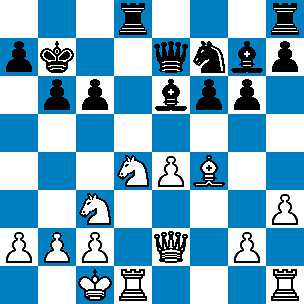
Black looks pretty solid here, right? Two bishops, a better pawn structure... 18.Nxc6! Boom shakalaka! 18.Nd5 also wins, but is much less fun. 18...Kxc6 19.Nd5! The point! The knight is immune from capture and the black king is starting to feel exposed. 19...Qe8 If 19...Qc5, then 20.b4! is decisive 20.Qa6 Bf8 21.Qxa7 Bc5 22.b4 Qd7 23.Qa6 1-0

The winner: GM Vladimir Akopian
Black looks pretty solid here, right? Two bishops, a better pawn structure... 18.Nxc6! Boom shakalaka! 18.Nd5 also wins, but is much less fun. 18...Kxc6 19.Nd5! The point! The knight is immune from capture and the black king is starting to feel exposed. 19...Qe8 If 19...Qc5, then 20.b4! is decisive 20.Qa6 Bf8 21.Qxa7 Bc5 22.b4 Qd7 23.Qa6 1-0
The winner: GM Vladimir Akopian
The complete crosstable can be found here.
1.28.2007
A Fascinating Endgame
The following game took place at the Pan-American Championships in Washington, D.C. between Christmas and New Years. The "Pan-Ams" is the most competitive team tournament of its kind and is open to any college or university in the Americas. This year, both teams we fielded here at UTD tied for first without dropping a single individual game! One of our critical matches took place in round 4, when UMBC-A squared off against UTD-B. The opposite-color bishop endgame that resulted on board 3 is of interest to any student of the game (WGM Katerina Rohonyan plays for UMBC and IM Dmitry Schneider plays for UTD).
Rohonyan, K (2354) - Schneider, D (2517) [A13]
Pan-American Championships (4), 29.12.2006
1.c4 e6 2.Nf3 d5 3.g3 Nf6 4.Bg2 dxc4 5.Qa4 c6 6.Qxc4 b5 7.Qc2 Bb7 8.O-O a6 9.d4 Nbd7 10.Rd1 c5 11.Bg5 Qb6 12.Nc3 Rc8 13.Qd2 c4 14.d5 Nxd5 15.e4 N5f6 16.Bxf6 Nxf6 17.e5 Nd5 18.Nxd5 Bxd5 19.Ng5 h6 20.Bxd5 hxg5 21.Be4 Qc7 22.Qxg5 g6 23.Qf6 Rg8 24.Qf3 Be7 25.Bb7 Rd8 26.Bxa6 Qxe5 27.Qc6 Kf8 28.Qxb5 Qxb5 29.Bxb5 Rb8 30.a4 Bf6 31.Rac1 Bxb2 32.Rxc4 Rb7 33.Rb1 Be5 34.Rc8 Kg7 35.Rxg8 Kxg8 36.a5 Bd4 37.Kf1 Rc7 38.Bd3 Rc3 39.Rd1 Bc5 40.a6 Ra3 41.Rd2 g5 42.Ke2 Kg7 43.Bc4 Rc3 44.Bd3 Ra3 45.Rc2 Bb6 46.h3 Kf6 47.Bc4 Kg7 48.Ra2 Rc3 49.Bd3 Ba7 50.Ra5 Kf6 51.Kd2 Rc5 52.Rxc5 Bxc5 53.f3 Ke5 54.Kc3 f5 55.Kc4 Bf2 56.Kb5 f4 57.g4 Kd6 58.Bf1?? Kc7 59.Bc4 Kb8 1/2-1/2
58.Bf1 was far too accommodating. White can play for a win with 58.h4!
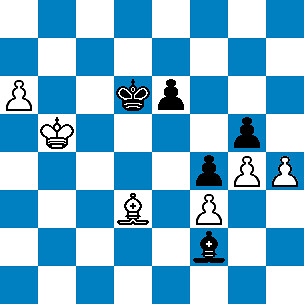
This is the position that IM Dmitry Schneider, GM Magesh Panchanathan (second board for UTD-A), and I spent quite some time analyzing in D.C. The play after 58...gxh4 59.Bf1 is extremely complex. I can't recall what conclusion we reached, but the consensus was that black is struggling. My personal analysis (see below) seems to support this.
So, if you really want a challenge...try to find a way for black to hold this! It's best to analyze these sort of endings with a group or with the aid of a strong chess engine. Post your comments if you find something good.
All of my analysis is here. It should save you quite a bit of time! Beware though...it is possible that black is simply lost.
Good luck!
Rohonyan, K (2354) - Schneider, D (2517) [A13]
Pan-American Championships (4), 29.12.2006
1.c4 e6 2.Nf3 d5 3.g3 Nf6 4.Bg2 dxc4 5.Qa4 c6 6.Qxc4 b5 7.Qc2 Bb7 8.O-O a6 9.d4 Nbd7 10.Rd1 c5 11.Bg5 Qb6 12.Nc3 Rc8 13.Qd2 c4 14.d5 Nxd5 15.e4 N5f6 16.Bxf6 Nxf6 17.e5 Nd5 18.Nxd5 Bxd5 19.Ng5 h6 20.Bxd5 hxg5 21.Be4 Qc7 22.Qxg5 g6 23.Qf6 Rg8 24.Qf3 Be7 25.Bb7 Rd8 26.Bxa6 Qxe5 27.Qc6 Kf8 28.Qxb5 Qxb5 29.Bxb5 Rb8 30.a4 Bf6 31.Rac1 Bxb2 32.Rxc4 Rb7 33.Rb1 Be5 34.Rc8 Kg7 35.Rxg8 Kxg8 36.a5 Bd4 37.Kf1 Rc7 38.Bd3 Rc3 39.Rd1 Bc5 40.a6 Ra3 41.Rd2 g5 42.Ke2 Kg7 43.Bc4 Rc3 44.Bd3 Ra3 45.Rc2 Bb6 46.h3 Kf6 47.Bc4 Kg7 48.Ra2 Rc3 49.Bd3 Ba7 50.Ra5 Kf6 51.Kd2 Rc5 52.Rxc5 Bxc5 53.f3 Ke5 54.Kc3 f5 55.Kc4 Bf2 56.Kb5 f4 57.g4 Kd6 58.Bf1?? Kc7 59.Bc4 Kb8 1/2-1/2
58.Bf1 was far too accommodating. White can play for a win with 58.h4!
This is the position that IM Dmitry Schneider, GM Magesh Panchanathan (second board for UTD-A), and I spent quite some time analyzing in D.C. The play after 58...gxh4 59.Bf1 is extremely complex. I can't recall what conclusion we reached, but the consensus was that black is struggling. My personal analysis (see below) seems to support this.
So, if you really want a challenge...try to find a way for black to hold this! It's best to analyze these sort of endings with a group or with the aid of a strong chess engine. Post your comments if you find something good.
All of my analysis is here. It should save you quite a bit of time! Beware though...it is possible that black is simply lost.
Good luck!
1.27.2007
Elista Revisited
The much-anticipated Topalov - Kramnik game ended in a draw today. Veselin was the one pressing for the full point, but Kramnik played like....well, Kramnik. The draw was agreed on move 49.
Topalov, V (2783) - Kramnik, V (2766) [D37]
Corus A Wijk aan Zee NED (12), 27.01.2007
1.d4 Nf6 2.c4 e6 3.Nf3 d5 4.Nc3 Be7 5.Bf4 0-0 6.e3 c5 7.dxc5 Bxc5 8.Qc2 Nc6 9.a3 Qa5 10.0-0-0 Be7 11.h4 Rd8 12.Nd2 dxc4 13.Nxc4 Rxd1+ 14.Qxd1 Qd8 15.Qxd8+ Nxd8 16.Be2 Bd7 17.e4 Bc6 18.f3 Nh5 19.Bc7 Rc8 20.Be5 Bf6 21.Nd6 Ra8 22.Bxf6 Nxf6 23.Rd1 Kf8 24.Kd2 Ne8 25.Nc4 f6 26.Ke3 b6 27.f4 Nf7 28.g4 h6 29.g5 hxg5 30.hxg5 Ke7 31.gxf6+ Nxf6 32.Rg1 Rg8 33.Rg6 Bb7 34.a4 Nh8 35.Rg1 Nf7 36.a5 g5 37.fxg5 Rxg5 38.Rxg5 Nxg5 39.e5 Nd7 40.Nd6 Bf3 41.axb6 axb6 42.Bxf3 Nxf3 43.Nc8+ Kd8 44.Kxf3 Nxe5+ 45.Ke4 Nc4 46.Kd4 Nxb2 47.Nxb6 Kc7 48.Nc4 Nxc4 49.Kxc4 1/2-1/2
Actually, the pregame antics from both players were much more entertaining than the game itself. Take a look at this 3 minute video shot by Chessvibes.
That looks more like the day after a nasty break-up with your girlfriend than the beginning of a top-class chess game. Those are two opponents who truly despise one another. No handshake, no talking, no smiling...even gazing into the general direction of the other player was taboo.
You really can't blame Kramnik. He has had to deal with more whining, complaining, and mud-slinging from the Topalov camp post-Elista than is warranted. I'm sure Vladdy couldn't hide a smile when the German newspaper Suddeutsche Zeitung published allegations of cheating by Topalov and his (crazy) manager Silvio Danailov in rounds 2 and 3 at Corus. Chessbase has a nice english translation of this article. It is a fascinating and incriminating read.
Topalov, V (2783) - Kramnik, V (2766) [D37]
Corus A Wijk aan Zee NED (12), 27.01.2007
1.d4 Nf6 2.c4 e6 3.Nf3 d5 4.Nc3 Be7 5.Bf4 0-0 6.e3 c5 7.dxc5 Bxc5 8.Qc2 Nc6 9.a3 Qa5 10.0-0-0 Be7 11.h4 Rd8 12.Nd2 dxc4 13.Nxc4 Rxd1+ 14.Qxd1 Qd8 15.Qxd8+ Nxd8 16.Be2 Bd7 17.e4 Bc6 18.f3 Nh5 19.Bc7 Rc8 20.Be5 Bf6 21.Nd6 Ra8 22.Bxf6 Nxf6 23.Rd1 Kf8 24.Kd2 Ne8 25.Nc4 f6 26.Ke3 b6 27.f4 Nf7 28.g4 h6 29.g5 hxg5 30.hxg5 Ke7 31.gxf6+ Nxf6 32.Rg1 Rg8 33.Rg6 Bb7 34.a4 Nh8 35.Rg1 Nf7 36.a5 g5 37.fxg5 Rxg5 38.Rxg5 Nxg5 39.e5 Nd7 40.Nd6 Bf3 41.axb6 axb6 42.Bxf3 Nxf3 43.Nc8+ Kd8 44.Kxf3 Nxe5+ 45.Ke4 Nc4 46.Kd4 Nxb2 47.Nxb6 Kc7 48.Nc4 Nxc4 49.Kxc4 1/2-1/2
Actually, the pregame antics from both players were much more entertaining than the game itself. Take a look at this 3 minute video shot by Chessvibes.
That looks more like the day after a nasty break-up with your girlfriend than the beginning of a top-class chess game. Those are two opponents who truly despise one another. No handshake, no talking, no smiling...even gazing into the general direction of the other player was taboo.
You really can't blame Kramnik. He has had to deal with more whining, complaining, and mud-slinging from the Topalov camp post-Elista than is warranted. I'm sure Vladdy couldn't hide a smile when the German newspaper Suddeutsche Zeitung published allegations of cheating by Topalov and his (crazy) manager Silvio Danailov in rounds 2 and 3 at Corus. Chessbase has a nice english translation of this article. It is a fascinating and incriminating read.
Gibtelecom Masters
Well I promised that this wouldn't be just a chess "news" blog, and here I am making another tournament post! My bad. Anyways, you should scope out the Gibtelecom Masters, a very strong 9-round Swiss currently underway in Gibraltar. GM Ivan Sokolov has jumped out to a 4-0 lead, but he will have a tough time dealing with the host of Grandmasters nipping at his heels. A notable competitor at 3.5 points is Super-GM Michael Adams of England, who sports an intimidating 2735 FIDE. Shouldn't he be at Corus or something?!
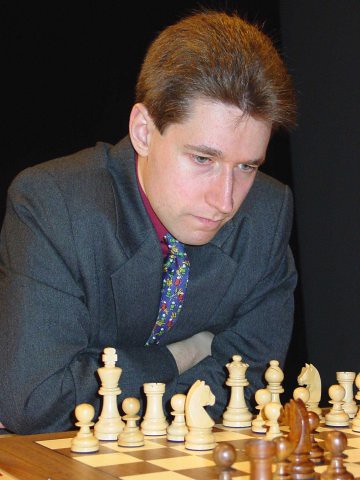
Our own Hikaru Nakamura is also in the field. He seems to have recovered after a first round loss to Ketevan Arakhamia of Georgia (the country, not the state), and I certainly hope he can continue to climb the leaderboard.
I'll try and annotate some of the games from this tournament for my next update. Meanwhile, Monroi can satisfy your live viewing needs.
Michael Adams
Our own Hikaru Nakamura is also in the field. He seems to have recovered after a first round loss to Ketevan Arakhamia of Georgia (the country, not the state), and I certainly hope he can continue to climb the leaderboard.
I'll try and annotate some of the games from this tournament for my next update. Meanwhile, Monroi can satisfy your live viewing needs.
The Najdorf in Corus: Part IV
Fresh, round 11 action from Corus today. Svidler - Topalov saw another English attack, this time with the prophylactic 10...h5!?
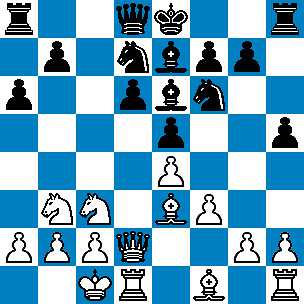
To be honest, I find this approach to be extremely attractive for black. Investing a tempo to shut down g2-g4 is often a good idea. Following 11.Kb1 Qc7, Svidler tried 12.Bd3. A curious choice, considering that Karjakin obtained a promising game against Topalov in round 3 with the simple 12.h3. Svidler misplayed the position and allowed the former world champion to build a decisive attack:
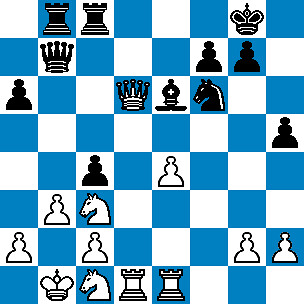
Would you believe that Topalov was the one who was lost in only 15 more moves? Have a look at the disaster here.
To be honest, I find this approach to be extremely attractive for black. Investing a tempo to shut down g2-g4 is often a good idea. Following 11.Kb1 Qc7, Svidler tried 12.Bd3. A curious choice, considering that Karjakin obtained a promising game against Topalov in round 3 with the simple 12.h3. Svidler misplayed the position and allowed the former world champion to build a decisive attack:
Would you believe that Topalov was the one who was lost in only 15 more moves? Have a look at the disaster here.
1.26.2007
The Najdorf in Corus: Part III
Yet another theoretical battle in the English Attack! This Round 10 match pitted young Sergey Karjakin against Vishy Anand. Everyone predicted this game to be exciting - both players are considered to be leading opening theoreticians.
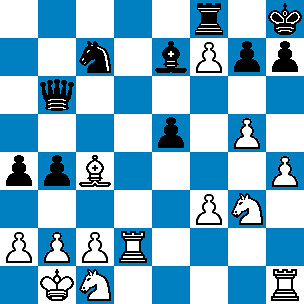
This position was reached after white's 23rd move. Those of you with a good memory may recall seeing it before...Karjakin certainly has! At Corus 2006, he was on the black side of it against Peter Leko. There he chose 23...Qc6 and the game ended in a premature draw. Here, Anand showed his subtle understanding of the position by playing 23...Nb5!. After an exchange of rooks, Karjakin's pieces became tied down and he was forced to resign on move 63.
As usual, you can download my notes to the game here.
This position was reached after white's 23rd move. Those of you with a good memory may recall seeing it before...Karjakin certainly has! At Corus 2006, he was on the black side of it against Peter Leko. There he chose 23...Qc6 and the game ended in a premature draw. Here, Anand showed his subtle understanding of the position by playing 23...Nb5!. After an exchange of rooks, Karjakin's pieces became tied down and he was forced to resign on move 63.
As usual, you can download my notes to the game here.
1.25.2007
The Najdorf in Corus: Part II
Last update saw Anand wheeling out 6.Bg5, a line that is less popular these days. Here we will examine another Round 9 matchup featuring the more "modern" English Attack. It would be easy to expect Alexei Shirov (white) to settle for a quick draw in this line, but the Latvian showed his fighting spirit.
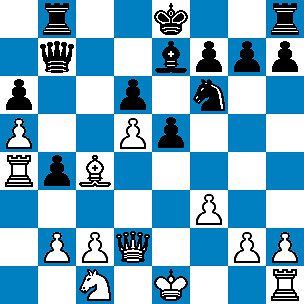
In this position, Ponomariov (black) played 19...Bd8?!, a move I have always thought was inferior to 19...0-0. The turning point of the game was reached after the subsequent 20.b3! 0-0 21.Na2 e4!? 22.Nxb4! Re8 23.Kd1 e3
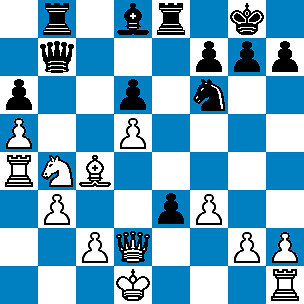
Where to put the queen? Tapan Sammalvuo makes a case for 24.Qe2! in his 2004 book "The English Attack," and I agree that this is probably best. Unfortunately, Shirov chose 24.Qc3?! and the game liquidated into a drawn opposite-colored bishop endgame.
You can download my CB notes to this game here.
In this position, Ponomariov (black) played 19...Bd8?!, a move I have always thought was inferior to 19...0-0. The turning point of the game was reached after the subsequent 20.b3! 0-0 21.Na2 e4!? 22.Nxb4! Re8 23.Kd1 e3
Where to put the queen? Tapan Sammalvuo makes a case for 24.Qe2! in his 2004 book "The English Attack," and I agree that this is probably best. Unfortunately, Shirov chose 24.Qc3?! and the game liquidated into a drawn opposite-colored bishop endgame.
You can download my CB notes to this game here.
The Najdorf in Corus: Part I
Lately, I have annotated several games from the A-group at Corus. As usual, the Najdorf Sicilian has featured prominently in these top-level encounters. Have a look at Anand - van Wely from round 9, in which the dutchman essayed the highly theoretical Poisoned Pawn variation:
1.e4 c5 2.Nf3 d6 3.d4 cxd4 4.Nxd4 Nf6 5.Nc3 a6 6.Bg5 e6 7.f4 Qb6 8.Qd2 Qxb2 9.Rb1 Qa3 A standard position for this variation. Anand now played the lively 10.e5!?
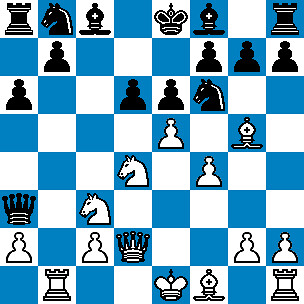
Amusingly, the players followed Motylev - Anand(!) from Round 2 until move 20:
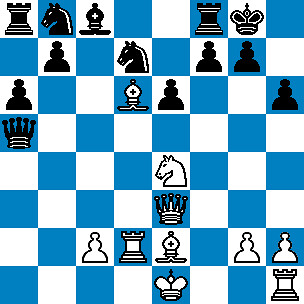
Instead of trying to duplicate Anand's success with 20...Rd8, van Wely - presumably spooked by some home preparation from Vishy - tried 20...Nc6?! and lost quickly.
I uploaded my comments on this game in Chessbase format to FileDen. Download it here.
Another Najdorf game on the way for tomorrow!
1.e4 c5 2.Nf3 d6 3.d4 cxd4 4.Nxd4 Nf6 5.Nc3 a6 6.Bg5 e6 7.f4 Qb6 8.Qd2 Qxb2 9.Rb1 Qa3 A standard position for this variation. Anand now played the lively 10.e5!?
Amusingly, the players followed Motylev - Anand(!) from Round 2 until move 20:
Instead of trying to duplicate Anand's success with 20...Rd8, van Wely - presumably spooked by some home preparation from Vishy - tried 20...Nc6?! and lost quickly.
I uploaded my comments on this game in Chessbase format to FileDen. Download it here.
Another Najdorf game on the way for tomorrow!
1.24.2007
Blog Launch... Plus A Little Background Info

Welcome to my new blog! My name is John Bartholomew, and I am a 20 year-old IM-elect from Eagan, Minnesota. I am currently a sophomore at the University of Texas-Dallas (UTD) pursuing a degree in Business Administration. I have played competitive chess on the American circuit for the past 10 years. Some of my accomplishments include a tie for first in the 2001 National Junior High School tournament, clear first in the 2002 National High School tournament, and the accumulation of 4 International Master norms from tournaments in Philadelphia, Las Vegas, and Dallas.
More than anything though, I am a chess fan. This crazy game has already provided me with so many opportunities in life that I somehow feel obligated to return the favor.
The origin for this blog is a 250+ page Word document of mine that is roughly five years old and has survived on more than a few laptops and flash drives. It contains the sum of my chess experiences: my thoughts, analysis, games, goals...you name it! I've never shown it to anyone, nor do I plan to in the future (I'm sure all of you are oh so eager to see it anyways). Writing is one of my passions, and this "living" document will always be a work in progress.
Oh right...the blog! The blog you're reading now will hopefully be my small contribution to the promotion, discussion, and appreciation of anything having to do with chess. I hope to translate much of what I have written about privately to a more public forum. I will do my best to update it frequently, but with a full class schedule and social college life I can hardly make such promises! I don't intend for this to read strictly as a chess "news" site, though current events in chess will certainly be featured. Rather, I intend to post things that will most interest casual or competitive players: game analysis, chess psychology, first-hand tournament reports, openings theory...the possibilities are endless.
I will end my first post with a plea to you, the reader: please, please, please give me your feedback! I don't claim to know everything about chess, nor do I want to give that impression. I'm simply an experienced player who hopes to use my knowledge of the game to make a site like this work. I want to know what you think! E-mail me your questions, things you want to see discussed...anything. Heck, just introduce yourself. You can reach me at: john.bartholomew@student.utdallas.edu
Thanks again for reading. Check back soon!
Subscribe to:
Posts (Atom)